



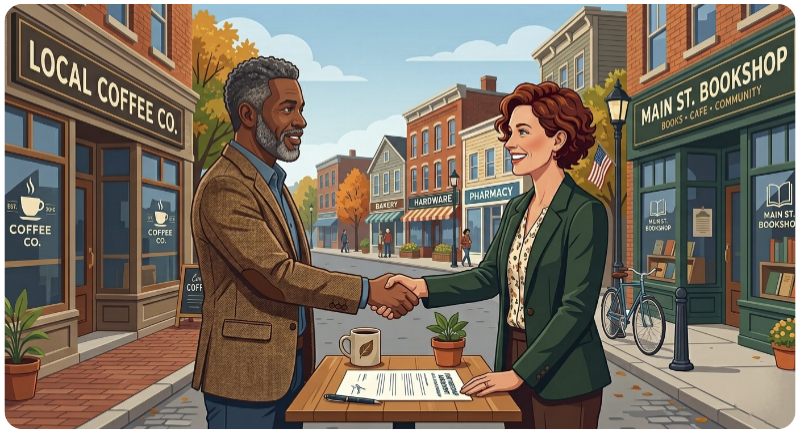
The idea of doing business on a handshake can sound almost quaint now. Most modern business owners are used to contracts, email chains, payment terms, digital signatures, and enough legal wording to make a simple agreement feel like a mortgage application.
But our survey suggests the old “your word is your bond” mindset has not disappeared entirely. It has simply retreated into the places where people still know each other, talk about each other, and remember who followed through.
We polled 3,005 small business owners across the US and Canada to find out where the handshake economy still has life in it. Respondents were asked whether people in their town are still more likely to do business on a verbal agreement or handshake than through written contracts.
Key Findings
The driver is not nostalgic.
What stands out immediately is that this is not really a nostalgia story. It is not simply about older towns clinging to old habits.
The pattern is more practical than that. In places like Greeneville, Oxford, Mountain Home, Murray, and Boone, business relationships are often built through repeat contact.
The same person might be a customer, supplier, neighbor, parent at the school, church member, alumni contact, or friend-of-a-friend. In that kind of environment, trust is not abstract. It is trackable.
Handshake economies rely on visibility.
The top 10 also show how much the handshake economy depends on visibility. A handshake only works when there is some kind of social accountability behind it. Greeneville, Tennessee, topped the U.S. list, followed by Oxford, Mississippi, and Mountain Home, Arkansas – all places where reputation can move quickly through local networks.
These are not anonymous business environments. If someone acts unethically, the local community is likely to know about it.
Handshake economies are particularly strong in the South.
The South had a particularly strong showing near the top of the ranking. Tennessee, Mississippi, Arkansas, Kentucky, North Carolina, South Carolina, and Alabama all appeared in the U.S. top 10.
That may point to the lingering strength of relationship-based business culture in smaller Southern communities, especially where Main Street life, local contractors, family businesses, and civic groups still overlap. The “handshake” here is not just a romantic image. It is part of how trust is socially enforced.
Kentucky’s performance is especially interesting. Murray ranked fourth, Danville seventh, and Bardstown appeared at #21, giving the state several strong entries in the upper tier.
That suggests the state’s smaller cities may have a particularly strong mix of local pride, compact business networks, and repeat relationships. In these places, being known locally may still be as important as having the sharpest sales pitch.
Canadian handshake economies have a more practical edge.
While Canadian towns follow a similar trajectory as American ones, the handshake economies appear to have a more in-built practical edge.
Towns such as Dawson Creek, British Columbia, Portage la Prairie, Summerside, Kenora, and Miramichi would not be described as quaint, but they feel more connected to resource work, agriculture, logistics, fisheries, trades, tourism, and regional services.
The Canadian handshake economy, at least in this ranking, feels less ceremonial and more about being able to count on people when conditions are demanding.
The social bond creates the contract.
Small business owners are not naive about handshake deals. The counterparty will understand that in small communities, a failed handshake deal does not just create a business problem. It can create a social one.
Handshake deals may only work in small towns.
The handshake survives where the stakes are manageable and where the relationship itself provides some accountability. The most telling result may be the 85% who agreed that reputation travels faster in small communities.
That is the engine behind the whole handshake economy. In a large city, a bad deal can disappear into the noise. In a smaller town, it has legs. People talk. Business owners compare notes. Contractors get recommended or quietly avoided. A person’s reputation becomes a kind of informal credit score.
Final Thoughts
The handshake economy is not dead, but it has become more selective. Few business owners would argue that contracts no longer matter, and the survey makes clear that people understand the risks of relying only on someone’s word.
But the findings also show that formal paperwork has not replaced trust. It has simply moved alongside it.
For small businesses, the deeper lesson is that reputation remains a real asset. Being known for paying on time, doing good work, keeping promises, and treating people fairly still has commercial value, especially in communities where people talk, recommend, and remember.
A handshake may not be enough for every deal in 2026, but in the right town, with the right person, it still means something.